There's an Arab expression "When you allow a snake to live in your garden, it will eventually come into your house." I heard it used this week in reference to Osama Bin Laden, but that's not what this blog post is about.
When I was first learning about Scrum, one of the thoughts that kept surfacing is that Scrum won't fix all your problems, but it will make them more visible, kind of like making that snake visible. The next step then would be to fix the problems (get rid of the snake). While Scrum does talk about inspect and adapt, it's really focused on the team level. Sometimes the problems you may face are bigger then that, and Scrum doesn't provide the solution to fix them.
This is where Lean can help out. A key principle of Lean is looking at the entire value stream, not just your development lifecycle. I had a conversation lately about organizations that have separate QA teams that do the testing after development. In a non-Lean organization I was working at, there was a handoff to QA after development, which resulted in a number of problems that caused delays. If we took a Lean approach, we would have worked with QA to optimize the entire process. So we failed to get the snake out of our garden.
What snakes are in your garden?
Wednesday, May 04, 2011


Tuesday, April 26, 2011
Personal Kanban - Week 1
So I'm in my first week of using a personal kanban board. So far I think it's a success.
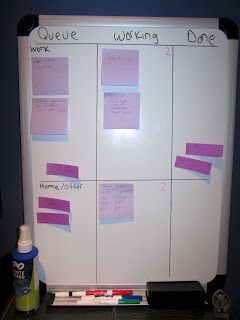
I set it up last Friday afternoon. It was a good way to wrap up the week and make sure I wasn't forgetting any tasks that had to get done before I called it a day. It also worked well when I walked in my office on Monday morning - a quick, visual reminder of what I have going on.
Here's how I set things up;
- I have two swim lanes, one for work, the other for home/other projects (such as volunteer work). Within each, I set a limit of 2 items for work in progress. We'll see how well that works in a couple weeks when I'm running 2 different projects.
- I use small stickies for tasks that are small, around a couple hours or less. I have big notes for more involved work. On these, I jotted down important details. For example, the task to prepare for my presentation at PMI has key dates I have to meet.
- I'm going to keep things in "done" throughout the week and use this to help me do my timesheet at the end of the week.
- I am still keeping a "To-Do" list of short, quick things I have to do. I haven't made up my mind on the best way to handle these items.

I haven't figured out what I'm going to do when I'm traveling. I think I'm going to use a notebook to capture what I have to do when traveling and write things down that have to go on the board when I get home. Stay tuned for updates.
Wednesday, April 13, 2011
Pirates and Leadership
There was an interesting article in Harvard Business Review last fall about star and guardian tasks. Star tasks are those that are more strategic while guardian tasks are more operational. The article discussed how effective pirate ships were at dividing these tasks, since one person is typically not good at performing both kinds of tasks.
The world of project management is the same. The star tasks would be having a vision for the product or seeing the big picture. These are tasks often associated with the product owner or sponsor. The guardian tasks would include planning out the work, getting the right resources, or managing the budget; obviously more in line with the project manager.
So just like the pirate ship, with a captain to handle the star tasks and a quartermaster to handle the guardian tasks; you should keep these to roles separate on your project. And as the project manager, if you have a team member out of line, you can make them walk the plank.
Wednesday, April 06, 2011
Divisive Speech
Part of Buddhist practice includes avoiding the 10 non-virtuous actions. One of these actions is divisive speech. I think this project managers should pay attention to this one.
Divisive speech can be thought of as any words that can bring disharmony or create animosity. Politicians do this a lot; trying to create a division between themselves and their opponents while making their opponents look bad.
This type of speech can happen on a project team as well. While I feel conflict can be good, if the conflict includes divisive speech, it can hurt the team. For example, discussing the merits of .NET or Java can be a healthy discussion, but when it turns to insults, there's no benefit.
A successful project relies on a effective project team. This takes time to develop. It's the project manager's job to see that this happens. It can be as simple as having some ground rules established at the start of the project that guides the right behavior. Once the team gets rolling, these rules won't be necessary but during the forming/storming stages, they can help the team move in the right direction. What ground rules do you put in place at the start of a project to ensure your team's success?
Wednesday, March 23, 2011
Problem Solving and Climbing
This past weekend I did some rock climbing at Horseshoe Canyon Ranch in Jasper Arkansas. This was the first time I've ever done any climbing outdoors, after doing gym climbing for the past few months.
Outdoor climbing was a lot different from climbing in the gym. In the gym there are a set of holds that you follow as you climb up, all marked with colored tape so you know where to go next. Outdoors, you have to figure out where to grab and step. It becomes a problem solving activity as much as a test of physical capability to get to the top.
I thought about how this resembles the difference between taking a training class and working in the real world. A training class is like the gym, you are guided along. In the real world, you have to take what you learned in training and use that to solve problems you didn't face in the gym, or class.
As this was my first time outdoors, I have a lot to learn about climbing, just like a new project manager. It will only be through experience that I learn how to climb better. The other thing I had was a group of more experienced people to help show me the way, just like a new project manager should have a coach or mentor to help show them the way. No one can climb that cliff for me, but they can help me see the path.
Thursday, March 10, 2011
Multi-tasking and Creativity
I've written before about multi-tasking (here, here, and here). In general, I think multi-tasking doesn't work and should be avoided. But does it hamper creativity?
In a study done by Teresa Amabile and others (see footnote), they found that having a fragmented day (ie, multi-tasking) didn't help bring out more ideas. Focusing on a single topic and collaborating with a single individual increased creativity.
I think about my typical day on site with a client. I have multiple meetings on different topics and don't seem to get a lot deep thinking work done. On Fridays, when I work from home and have more control over my day (and less meetings), I can carve out a large chunk of time to focus on a single topic and that's when I come up with some good solutions.
I've heard of organizations that are going to no email Fridays. I think the benefits will be the same. Without the distraction of email, they can focus on a single problem and let the creativity flow.
So pick a problem you've been trying to solve, block your calendar for half the day Friday, turn off the email, and get creative.
Teresa M. Amabile et al., “Time pressure and creativity in organizations: A longitudinal field study,” Harvard Business School working paper, Number 02-073, 2002
Monday, February 28, 2011
Why the PMI Agile Certification is a Good Thing
So by now the PMI Agile Certification is probably old news to most folks. There have been plenty of blog posts on the topic. One of my favorites was that of Dennis Stevens, found here.
I was thinking about the bigger picture of what the certification can mean. Back when I got my PMP certification (about 10 years ago now), not a lot of people knew what it was. Now most jobs for project managers ask for the PMP certification. With PMI's large membership and reach, I think this will help agile project management become more mainstream.
As a case and point, I started a new project the other week. The project included IT folks on the client side, plus some consultants (from one of the big firms). They talked about doing the project using agile and iterative techniques. I even spent time walking them through the agile methodology my company developed. However, two days later, they were asking when I would provide the "detailed project plan." It was clear that in spite of their words, they really didn't get what agile was.
Now that PMI is doing agile, it's going to get more attention among main-stream project managers. My hope is that people will at least take a few minutes to understand some of the principles (Dennis's post laid them out nicely). Now I know agile is not the right approach for every project. However, I think in order to make an informed decision, you need some facts. And when you find yourself in an agile project, you at least know the right questions to ask.
Subscribe to:
Posts (Atom)